// Enterprise Website Modernization Case Study

Rebuilding a Century-Old Law Firm’s Website Into a Scalable Growth Platform

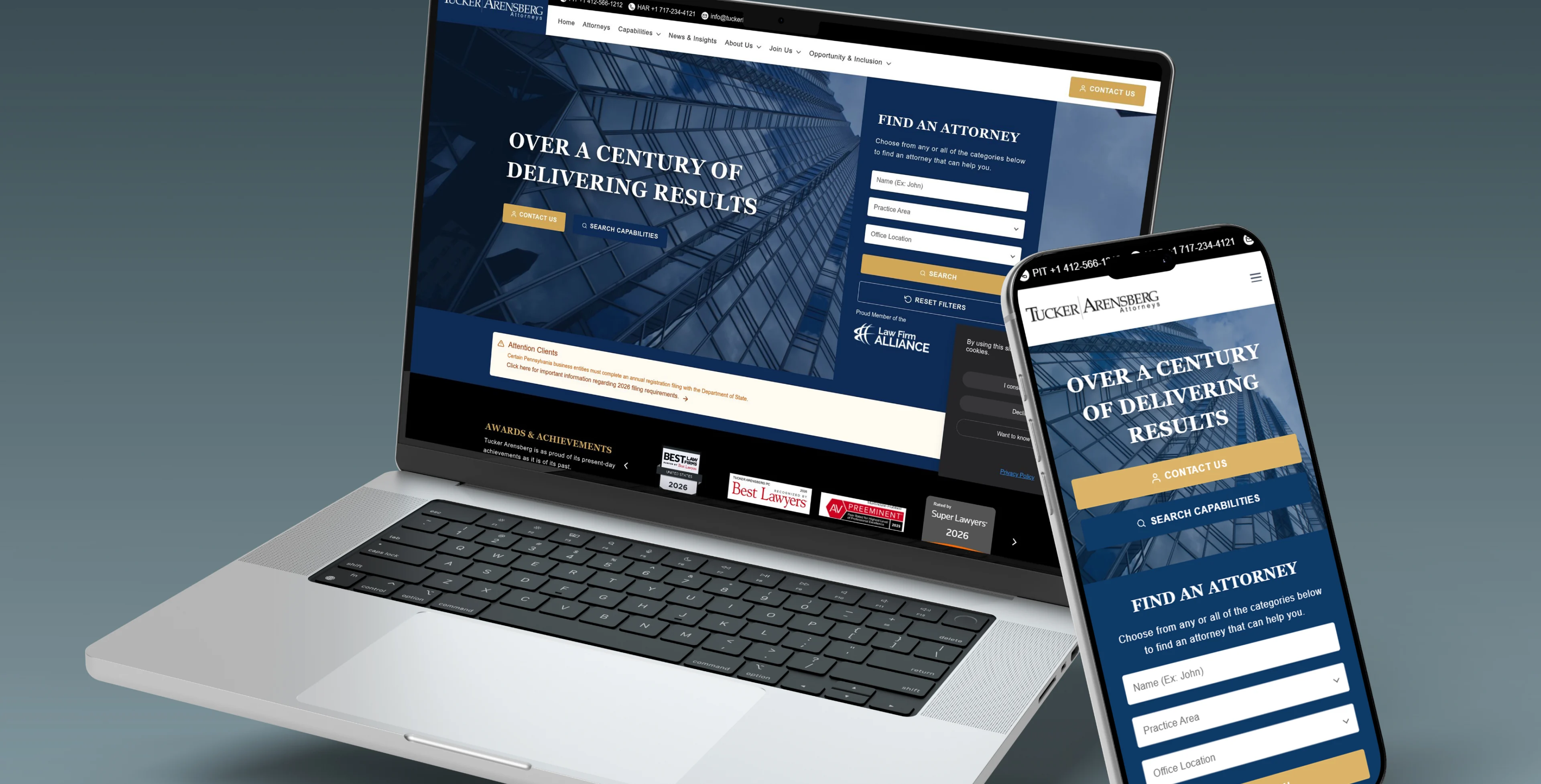
Tucker Arensberg’s modernization was a full platform rebuild—improving attorney discoverability, reducing reputational risk, and adding scalable governance. Genesys delivered a structured content model, role-based publishing workflow, and conversion tracking to create a stable, maintainable foundation for long-term growth.

Client
Tucker Arensberg, P.C.
Industry
Legal Services
Engagement Type
Full Website Redesign + Platform Re-Architecture
sample image

+36%

Contact Clicks

-90%

Admin Bottleneck

+27%

Organic Impressions

Comprehensive Project Scope

Phase 01

Discovery & Audit

Phase 02

IA & UX Design

Phase 03

Custom CMS Build

Phase 04

Content Model & Migration

Phase 05

RBAC Workflow

Phase 06

Data Migration

Phase 07

QA & Training

Outcome

Successful Modernization

sample image

What We Delivered

Deliverables were executed under enterprise change-management principles, prioritizing stability, auditability, and long-term maintainability over short-term visual gains.

  • Interactive IA map & cross-practice user flows

  • Custom WordPress component library

  • Relational CPT/ACF database schema

  • RBAC roles & publishing approval workflow

  • 1:1 Redirect map & SEO technical migration

  • GA4 event tracking & conversions framework

  • Full device/browser QA verification matrix

  • Attorney-facing training documentation

Platform Capabilities Delivered


Platform Architecture

  • Theme: 100% custom WordPress theme (no page builders) built for performance and longevity.

  • Editor: Built on WordPress with standard blocks for brand-consistent editing.

  • Relational Data Model: Custom field groups for bios, practices, and office entities.

  • Document Exports: One-click PDF generation for attorney bios and insights.

  • vCard Download: Save attorney contact details instantly for referral partners.

  • Lead Capture & Routing: Forms that sync to CRM and route inquiries by practice.

Governance + Risk Controls

  • Hardened Security Posture: Layered protection with firewall, malware scanning, and patch governance.

  • Accessibility: Improvements across navigation, contrast, and keyboard support (with an accessibility layer).

  • Technical SEO Migration: Redirect integrity, 404 monitoring, and taxonomy hygiene.

  • Performance: Consistent speed monitoring and reliable transactional email deliverability.

  • Measurement: GA4 event taxonomy and Search Console performance telemetry.

  • Ops & Integrity: Secure migration snapshots and data integrity workflows.

The Challenge: A Fragmented Legacy

Tucker Arensberg is a 100+ year old, multi-office, full-service law firm with nearly 100 attorneys. Headquartered in Pittsburgh, the firm operates across 5+ states. While the firm’s offline reputation was unquestioned, its digital presence did not reflect the depth, scale, or credibility of the organization.

For a firm of this scale, digital inconsistency represented not just a UX issue, but a reputational risk—where outdated or fragmented information could undermine trust with sophisticated legal buyers.

Before & After Modernization

Modernization focused on reducing cognitive risk for clients while restoring operational control for internal teams.

The Legacy State

  • Scattered navigation & cognitive overload
  • Static attorney bios with zero relational depth
  • Single-administrator bottleneck for all updates
  • Siloed taxonomy hurting search discoverability
  • No measurable conversion engine for leads

The Modern Platform

  • Intent-led IA & streamlined UX

  • Relational systems (bi-directional bios)

  • Role-based publishing workflow (RBAC)

  • Unified taxonomy & SEO-first architecture

  • Integrated conversion tracking & telemetry

Before & After Modernization

Security Posture

Hardened defense involving firewall, malware scanning, and a strict patch cadence with least-privilege roles.

Accessibility Readiness

Improvements across navigation, contrast, semantic structure, and keyboard support (with an accessibility layer to extend coverage).

Multi-Office Complexity

Designing for 5+ physical locations required a centralized yet flexible architecture that surfaces office-specific contact info contextually.

Future Scalability

The system had to support rapid addition of new practice areas, industries, and lateral hires without breaking the relational structure.

sample image

Strategic Audience Mapping

Large firms require a sophisticated understanding of multiple visitor intents. We mapped 6 distinct user journeys to ensure the platform converts at every level:

Each audience group was mapped not only by intent, but by decision authority, information sensitivity, and required confidence threshold—ensuring the platform supports both first-touch validation and final-stage engagement.

Decision-Makers & GC

Credibility-Driven

Quickly surface representative matters and industry depth to validate expertise for high-stakes seekers.

Referral Sources

Validation-Driven

Provide vCards and printer-friendly attorney profiles for professional-to-professional validation.

Media & Press

Exposure-Driven

Dynamic insights modules ensure attorneys are visible as subject matter experts for the press.

Lateral Hires

Culture-Driven

Elevated design and modern UX signal a forward-thinking firm that attracts top tier talent.

The "Attorneys First" System Design

To move beyond a static archive, we modeled the firm as a relational ecosystem. Attorneys, capabilities, industries, offices, and insights were defined as structured entities with bi-directional relationships.

This architecture established a single source of truth for attorney credentials, services, and insights—eliminating duplication, inconsistency, and manual reconciliation across the organization.

Entities:

  • Attorney Profile

  • Service Capability

  • Industry Focus

  • Office Location

  • Insight/Article

Relationships:

Many-to-Many mapping connects every attorney to their respective practices, offices, and publications automatically.


Output:

Dynamic aggregation modules surface content contextually (e.g., Article pages automatically surface “Related Attorneys” and “Related Services” with zero manual effort).

Data Schema Implementation

We implemented the relational model using CPT + ACF field groups with bi-directional relationships to power dynamic listings and contextual modules.

Attorney ↔ Capabilities ↔ Industries ↔ Offices ↔ Insights

Single-source-of-truth for taxonomy + relationships

Pillar 01: Information Architecture

The "Attorneys First" System Design

The Problem

The legacy website attempted to present everything at once. This created massive cognitive overload. Prospective clients seeking specific expertise could not find a clear path to conversion.

sample image

The Risk: Conversion Hesitation

Decision paralysis led to high bounce rates. Visitors seeking a specific attorney often got lost in broader practice pages, leading to lost consultation leads.

Strategic Response

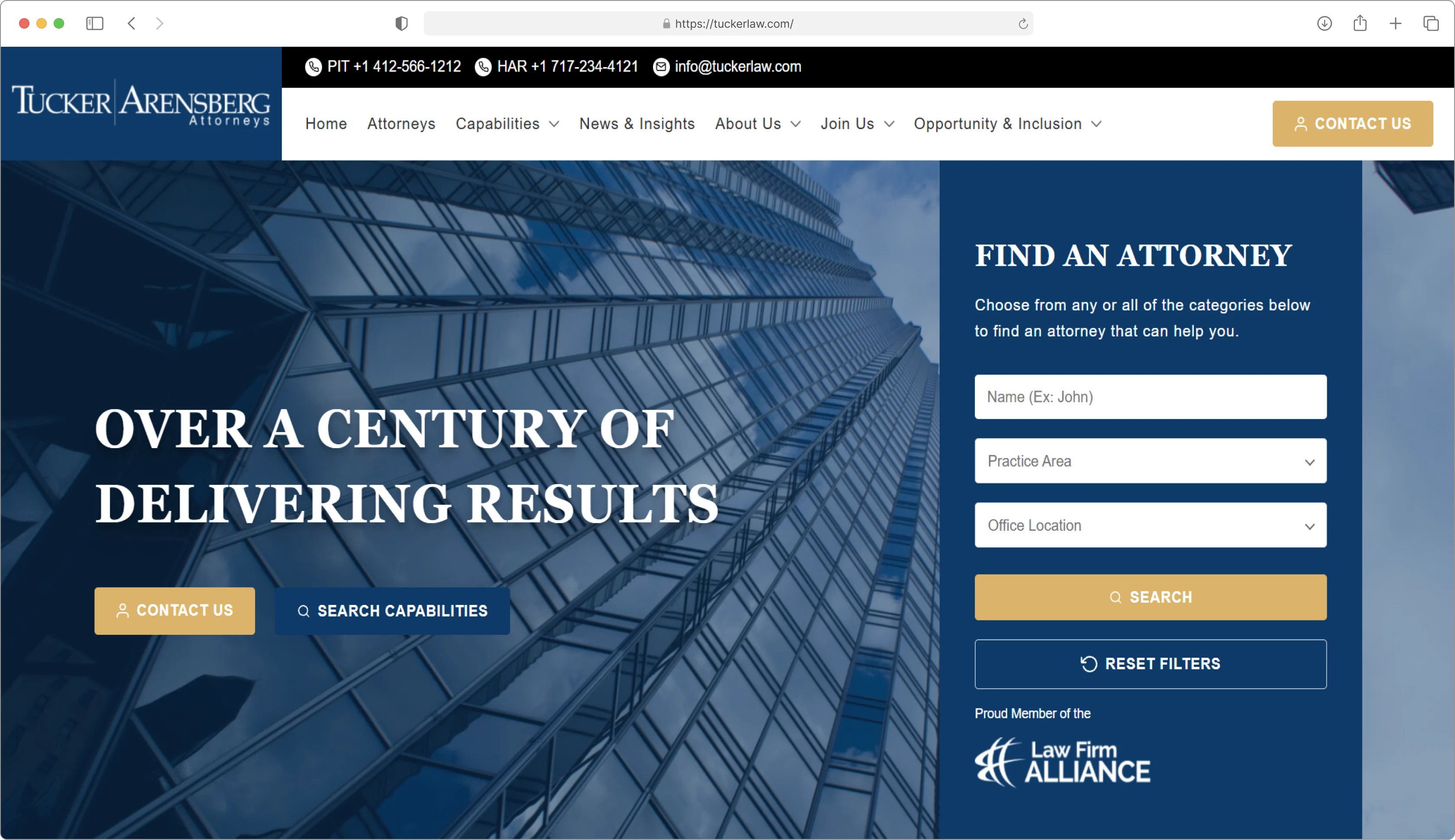
We implemented a progressive disclosure model. By stripping away homepage noise and focusing on high-intent CTAs like “Find an Attorney,” we guided users through a logical funnel from need to contact.

Observed Outcome: Engagement Quality

+42%

Session Duration

-31%

Bounce Rate

Pillar 02: Attorney Discoverability

Attorneys Were Invisible as Decision-Drivers

The Problem

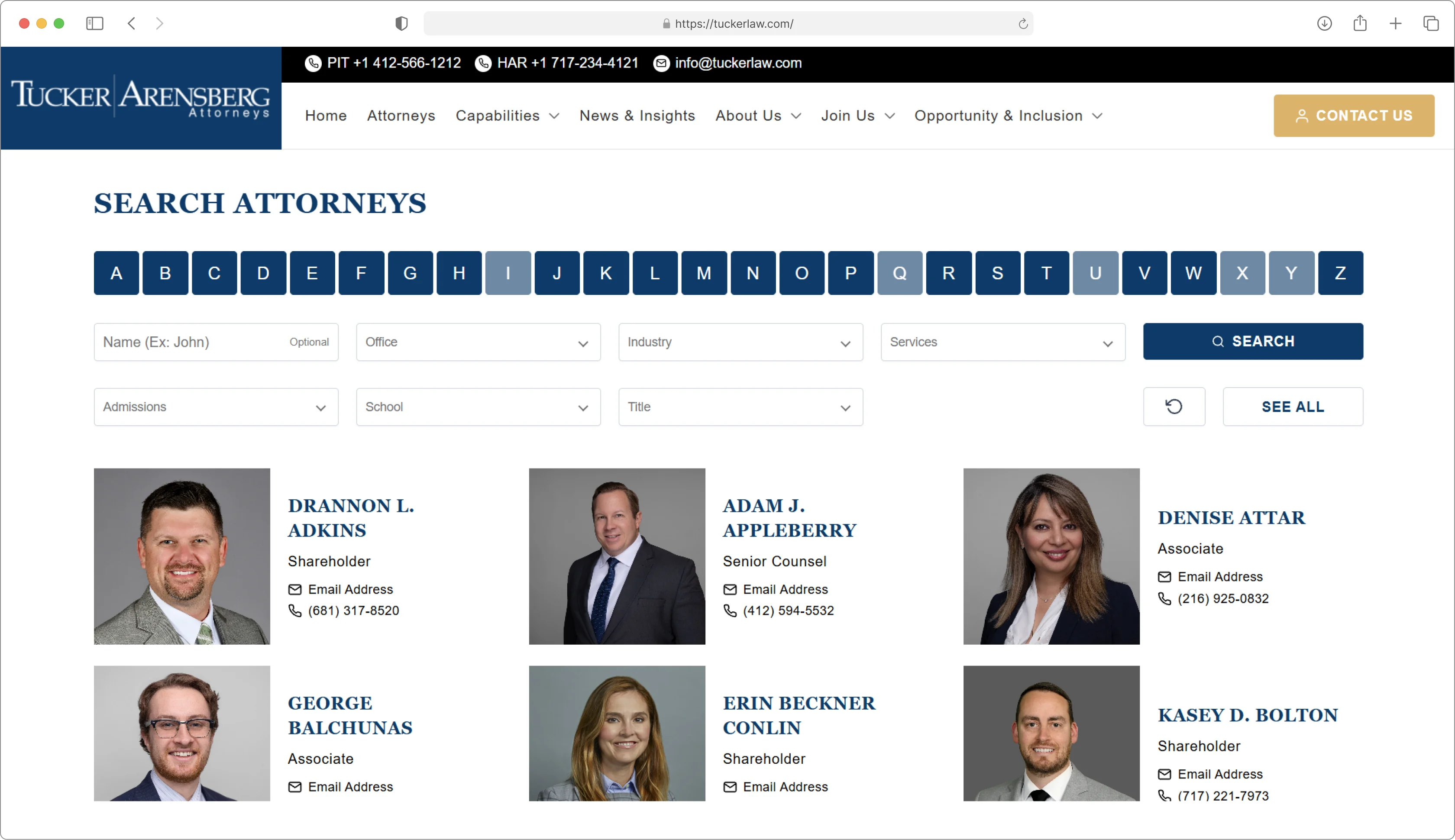
Despite being the firm’s strongest asset, attorneys were buried in static bios. Discovery was limited to long alphabetic lists, ignoring the fact that clients hire people, not firms.

sample image

Strategic Response

We rebuilt the platform around attorneys as first-class entities. Every bio page became a relational hub connected to practice areas, industries, and insights.

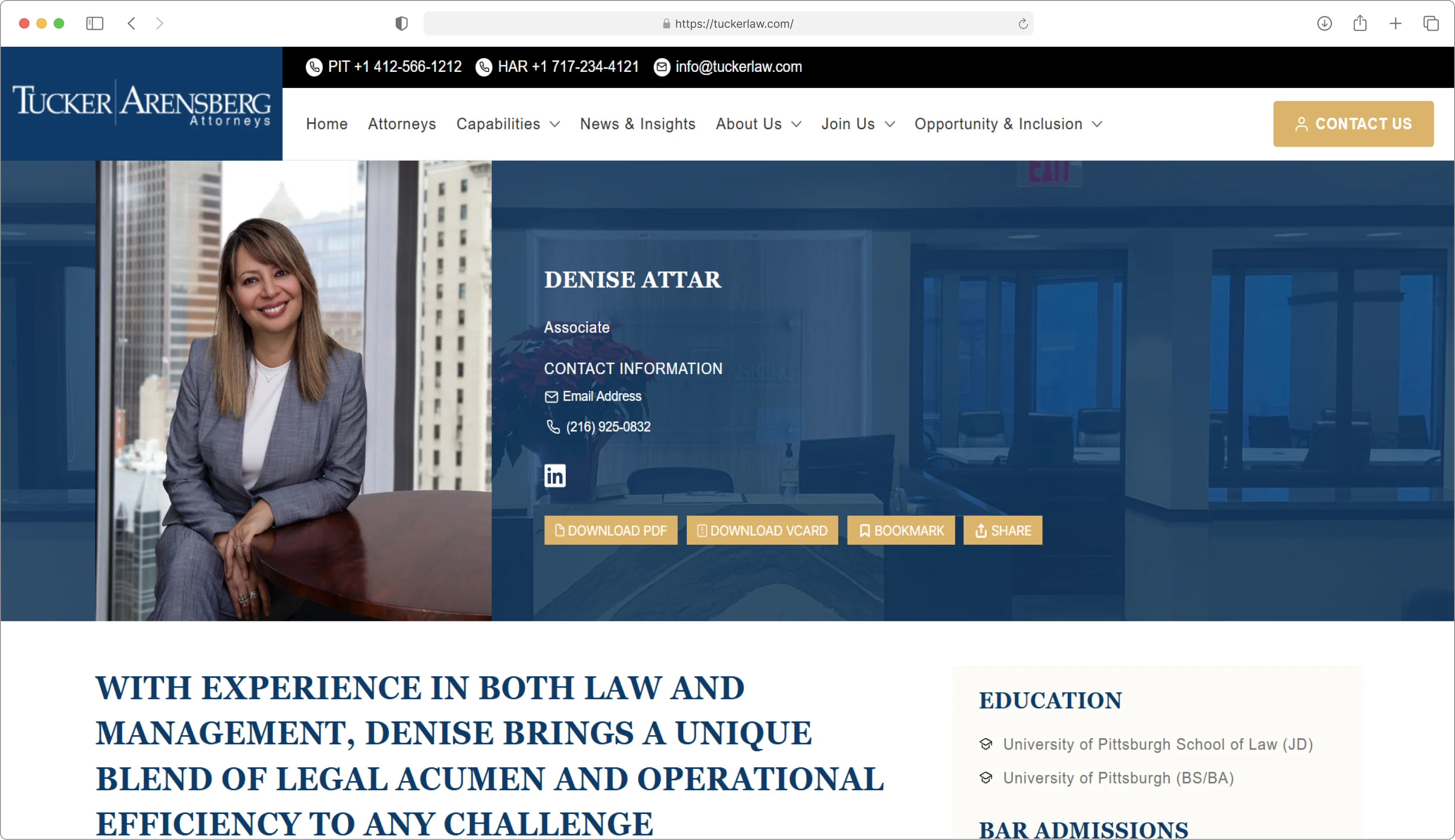
  • Direct Contact: Persistent reachable bars on bios surface phone/email without scrolling.

  • Micro-Conversions: “Download vCard” and “Print Bio” utilities for referral sources.

Referral-Ready Utilities

Download vCard (.vcf)

Enable assistants and referral partners to save attorney contact details in one click.

Document Exports

Generate professional court packets or internal review sheets from any attorney bio or insight page.

Observed Outcome: Lead Interaction

+36%

Contact Click-through

Based on tracked user interaction events

+58%

Profile View Depth

Pillar 03: Operational Governance

Admin Bottleneck: Operationally Unscalable Content

The Problem

A single administrator was responsible for 100+ attorney bios and publications. This caused content decay, outdated credentials, and stalled business development.

Strategic Response

We engineered a Role-Based, Modular CMS Architecture. Attorneys were empowered to update their own credentials while Marketing retained a central “Approve” layer.

Editorial Controls

  • RBAC Roles: Attorney (Draft) → Marketing (Approver).

  • Brand Lock: Templates prevent layout errors.

Technical SLA

  • Security: Monthly patch governance & vulnerability monitoring.

  • Backups: Daily off-site with quarterly restore drills.

90%

Reduction in admin bottlenecks


Content Ops Workflow

Phase A

Attorney → Draft

Phase B

Marketing → Review

Phase C

Admin → Publish

Template-locking via blocks prevents layout drift and maintains brand integrity across 100+ profiles.

Performance Analysis

Performance & Reliability

0.8s

LCP

Lighthouse Mobile

99.9%

Uptime

Reliability Score

0.02

CLS

Visual Stability

Technical buyers expect production-grade implementation. We moved the firm to a headless-ready architecture focused on visual stability. Deployment followed a strict Staging → QA → Production pipeline with defined incident response.

Pillar 04: Taxonomy & Technical SEO Architecture

Fragmented Taxonomy Hurting SEO & Discovery

The Problem

Services, Industries, and Departments were treated as separate silos. This internal structure caused navigation dead ends and diluted topical authority with search engines.

Strategic Response

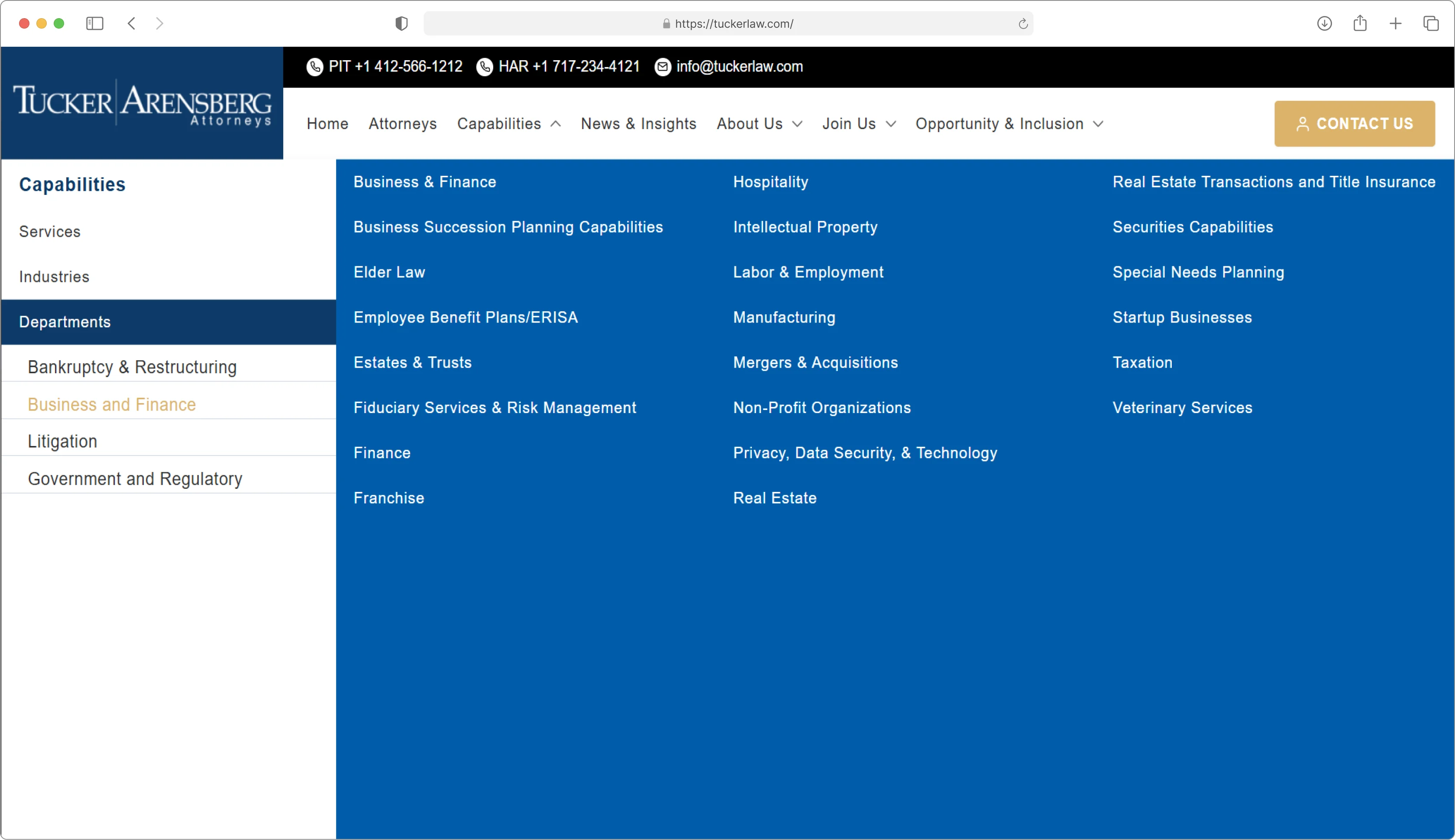
We normalized all offerings into a Unified Capability Hub. Every Practice page now dynamically aggregates related attorneys and recent thought leadership, keeping users in a discovery loop.

Observed Outcome: SEO Visibility

+27%

Growth in Organic Impressions

Based on organic visibility indicators following launch

Pillar 05: Brand Authority

Insights Were Underutilized

The Problem

With 100+ pages of high-value analysis, the firm's blog was a simple archive. It was disconnected from the practitioners and invisible to users in the research phase.

Strategic Response

We rebuilt the content system into a Thought Leadership Engine. Insights are now taxonomically linked to attorneys and services, ensuring “Expert Attribution” at every touchpoint.

Observed Outcome: Content ROI

+64%

Content Engagement

Based on post-launch engagement signals

+64%

Content Engagement

Based on post-launch engagement signals

Measurement & Risk Mitigation

Measurement Framework

Tracking Stack

Defined interaction events (calls, emails, form submissions, profile views), organic visibility indicators, and lead routing validation through operational workflows.

Comparison Window

Comparative analysis focused on pre-launch benchmarks and early post-launch performance trends across core practice and attorney profile pages.

Risk: SEO & Redirects

Migrating 100+ profiles carries a high risk of losing 10+ years of backlink authority.

Technical Migration Protocol Implemented

Mitigation: Full redirect mapping and visual verification audits at scale.

Risk: Stakeholder Approvals

Managing 100 legal professionals can stall production through approval silos.

Mitigation: Practice-group sprints with unified stakeholder sign-off.

Measurement references reflect platform-defined interaction signals and operational validation methods. No access to client-owned analytics accounts, proprietary dashboards, or confidential reporting systems is implied

From legacy website to a scalable, attorney-first growth platform

Tucker Arensberg’s modernization was not a visual refresh — it was a structural rebuild. Genesys transformed a fragmented legacy site into an attorney-first, relational platform with RBAC governance, a unified taxonomy, and measurable conversion instrumentation.

In the first 90 days post-launch, the firm saw stronger engagement, deeper attorney discovery, improved lead interactions, and reduced operational bottlenecks — proving the new platform is both a growth engine and a long-term enterprise foundation designed to scale across offices, practices, and future lateral growth.

The result is a platform that supports firm leadership, business development, and risk governance simultaneously—without increasing operational complexity.